Typhoid Vaccination In Manchester
Every year, people leave Manchester for destinations across South Asia, East Africa, Central America, and beyond. They do it to explore, to volunteer, to work, and to reconnect with family. Many of those journeys take travellers through regions where typhoid fever remains a genuine and present risk, spread through contaminated food and water in conditions that are difficult to avoid, even for the most careful traveller. Yet despite typhoid being one of the most well-established travel health concerns in the world, vaccination is frequently missed or arranged too late to be fully effective.
If you are preparing for travel from Manchester to a higher-risk destination, a typhoid vaccination should be one of the first items on your pre-travel health checklist. This guide explains what typhoid is, how the vaccine works, who needs it, and how to access a private typhoid vaccine in Manchester through our travel clinic.
What You Need to Know
- Typhoid fever is a serious bacterial infection spread through contaminated food and water, most common in parts of South Asia, Africa, and Central America
- The infection can cause severe illness, including high fever, abdominal pain, and even life-threatening complications
- A private typhoid vaccine in Manchester is available through specialist travel clinics and pharmacies
- Two forms of the vaccine are available, which are an injectable vaccine and an oral capsule course
- Vaccination should ideally be completed at least two weeks before travel to allow full immune protection to develop
- A pre-travel consultation is required before vaccination is administered
To arrange a private vaccine in Manchester, you can contact us or book an appointment online.
What Is Typhoid Fever?
Typhoid is a systemic bacterial infection caused by Salmonella enterica serotype Typhi, commonly referred to as Salmonella Typhi. It is a wholly human infection, meaning it does not have an animal reservoir. It is spread exclusively from person to person, typically through the faecal-oral route. In practice, this means that contaminated food, drinking water, or poor hand hygiene in food preparation are the primary routes of transmission for travellers.
Unlike many travel-related illnesses, typhoid does not simply cause an upset stomach and pass within a day or two. It is a serious systemic illness that affects the entire body. Without appropriate treatment, it can progress to severe and potentially life-threatening complications, including intestinal perforation, internal bleeding, and multi-organ involvement.
Typhoid fever affects around 21 million people globally each year and causes an estimated 200,000 deaths. In the UK, the vast majority of typhoid cases are acquired abroad, with the highest proportion linked to travel to or from the Indian subcontinent.
The illness typically begins one to three weeks after exposure. Initial symptoms include a steadily rising fever, headache, fatigue, and a general sense of feeling unwell. As the illness progresses, symptoms may include abdominal pain, constipation or diarrhoea, a characteristic skin rash of rose-coloured spots, and, in severe cases, confusion or reduced consciousness. Without appropriate antibiotic treatment, the illness can last for weeks and pose a significant risk of serious complications.
A closely related but distinct infection, paratyphoid fever, is caused by Salmonella Paratyphi and produces similar symptoms. Some typhoid vaccines also offer some protection against paratyphoid, and your healthcare professional will advise on this when discussing your options.
Where Is Typhoid Most Common?
Typhoid fever is most prevalent in areas of the world where access to clean water and adequate sanitation is limited or inconsistent. High-risk regions include:
- South Asia — particularly India, Pakistan, Bangladesh, and Nepal, which account for the majority of typhoid cases seen in UK travelers returning from abroad
- Sub-Saharan Africa — including parts of East, West, and Central Africa, where typhoid remains endemic
- Southeast Asia — including Indonesia, the Philippines, Cambodia, and parts of Vietnam
- Central and South America — particularly in areas where water treatment and sanitation infrastructure is less reliable
- Parts of the Middle East — in certain areas where sanitation conditions increase exposure risk
It is worth emphasising that even travellers staying in hotels and tourist resorts in these regions can be exposed to typhoid, as contamination can occur at any point in the food or water supply chain. The often-cited advice to avoid street food and stick to bottled water reduces risk but does not eliminate it entirely, which is why vaccination forms a critical additional layer of protection.
How Does The Typhoid Vaccine Work?
There are two forms of the typhoid vaccine currently available in the UK: an injectable vaccine and an oral vaccine taken as capsules. Both are effective, and the choice between them will depend on your age, travel timeline, and any clinical factors identified during your consultation.
The injectable typhoid vaccine (Vi polysaccharide vaccine) is given as a single injection, typically into the upper arm. It works by introducing a purified component of the outer surface of the Salmonella Typhi bacterium into your body. Your immune system identifies this antigen as foreign and generates a protective antibody response without you ever encountering the live bacterium. Protection develops within approximately two weeks of the injection and lasts for around three years, after which a booster dose is recommended if you remain at ongoing risk.
The oral typhoid vaccine is taken as a course of three capsules, taken on alternate days: day one, day three, and day five, for example. It contains a live attenuated (weakened) strain of Salmonella Typhi that stimulates an immune response in the gut without causing illness in healthy individuals. Because it is a live vaccine, it is not suitable for individuals who are immunocompromised or who are taking certain antibiotics. The oral vaccine must be completed at least one week before travel and should be stored in a refrigerator. Protection from the oral vaccine is estimated to last around three years.
Both vaccines work by training your immune system to recognise and respond rapidly to Salmonella Typhi if you are exposed during travel. Neither vaccine offers 100 per cent protection, which is why food and water hygiene precautions remain important even after vaccination.
Who Should Consider Typhoid Vaccination In Manchester?
Typhoid vaccination for Manchester travellers applies to a wide range of itineraries and purposes. You should discuss vaccination with a healthcare professional if you:
- Are travelling to South Asia, including India, Pakistan, Bangladesh, or Nepal, regardless of the nature or duration of your trip
- Are visiting East, West, or Central Africa, Southeast Asia, or Central and South America
- Are travelling to visit friends or relatives (VFR travel) in a high-risk region — a group that is statistically at higher risk of typhoid because they may stay in private homes, eat local food, and spend longer periods in affected areas
- Are travelling for extended periods of four weeks or more, particularly in regions where sanitation is variable
- Are planning travel that involves more remote areas, rural communities, or humanitarian or development work settings
- Are backpacking or travelling in a way that involves eating from local food stalls, markets, or street vendors
- Have had typhoid in the past, as previous infection does not guarantee lifelong immunity, and vaccination remains advisable
- Are travelling with young children to a high-risk destination, typhoid can be particularly severe in children
It is also worth noting that second-generation UK residents travelling to visit family in South Asia or East Africa are sometimes under the impression that their heritage or previous exposure confers immunity. This is a misconception as without confirmed vaccination or documented infection, these travellers carry the same risk as any other unvaccinated individual visiting a high-prevalence region.
Who Should Not Have The Typhoid Vaccine?
- Individuals with a known allergy to any component of the chosen vaccine formulation
- Those currently unwell with a high fever, for which vaccination should be deferred until recovery
- The oral typhoid vaccine is not suitable for individuals who are immunocompromised, including those on immunosuppressive medications, as it contains a live attenuated organism
- The oral vaccine should not be taken within three days of antibiotic use, as antibiotics may reduce its effectiveness
- The injectable vaccine is generally preferred in children under two years of age, and the oral vaccine is not licensed for children under six
- Anyone advised against vaccination following clinical assessment
A full clinical assessment will always be completed before any vaccination is administered at our Manchester travel clinic, ensuring the most appropriate formulation is selected for your individual circumstances.
Side Effects And Safety Considerations
Both formulations of the typhoid vaccine have well-established safety profiles and are generally well tolerated.
Injectable vaccine — common side effects:
- Pain, redness, or tenderness at the injection site
- Mild fever or feeling generally unwell for a day or two following vaccination
- Headache or fatigue
Oral vaccine — common side effects:
- Nausea or stomach discomfort
- Headache
- Mild fever or abdominal cramps
- Diarrhoea in some individuals
Rare side effects (both formulations):
- Allergic reaction, including, in very rare cases, a severe allergic response
- Persistent or unusual symptoms that require medical review
Side effects from either form of the typhoid vaccine are typically mild and short-lived. If you experience anything that concerns you following vaccination, you should seek medical advice promptly.
Typhoid Protection: Vaccinated vs Unvaccinated Travellers
Food And Water Hygiene: Still Important After Vaccination
While the typhoid vaccine provides strong protection, it is not 100 per cent effective. Efficacy estimates for both formulations range from approximately 50 to 80 per cent under real-world travel conditions. This means that food and water hygiene precautions remain an important part of your overall strategy for avoiding typhoid abroad, even after vaccination.
Key precautions include drinking only bottled or properly treated water, avoiding ice in drinks unless you are confident it was made from safe water, eating food that has been thoroughly cooked and is served hot, avoiding raw salads and unpeeled fruit or vegetables that may have been washed in contaminated water, and being cautious with shellfish and dairy products in high-risk areas.
Vaccination and hygiene work best in combination. Neither alone provides complete protection, but together they substantially reduce your risk of becoming unwell with typhoid during travel.
Where Can I Get A Private Typhoid Vaccine In Manchester?
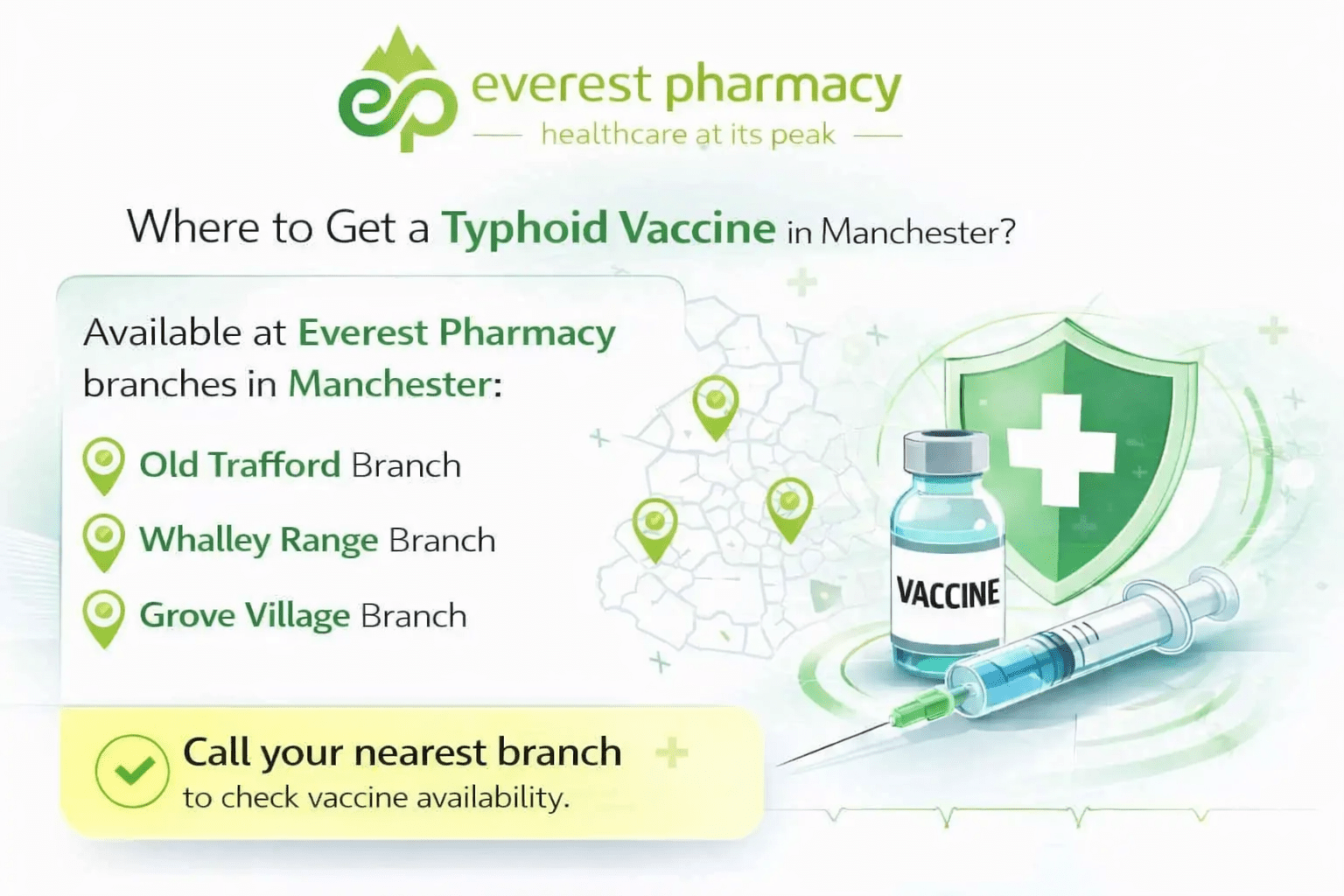
A private typhoid vaccine in Manchester is available through registered travel clinics and pharmacies with specialist travel health expertise. At Everest Pharmacy, we offer a comprehensive pre-travel health consultation that covers your full vaccination needs, health risks specific to your destination, and any additional precautions relevant to your trip.
The process typically involves:
- Booking a travel health consultation at a time that suits you
- Discussing your destination, activities, duration of travel, and existing vaccination history with one of our healthcare professionals
- Selecting the most appropriate typhoid vaccine formulation (injectable or oral) based on your individual circumstances
- Receiving your vaccination or oral vaccine prescription on the same visit where clinically appropriate
- Obtaining a vaccination record for your personal health documentation
- Receiving tailored advice on food and water hygiene and any other relevant travel health precautions
To arrange a private vaccine in Manchester, you can contact us or book an appointment online.
What To Expect From Your Appointment
- A thorough discussion of your travel itinerary, including specific countries and regions visited, length of stay, and type of accommodation
- A review of your vaccination history to identify any existing cover or gaps across all relevant travel vaccines
- Clear guidance on which typhoid vaccine formulation is most suitable for you and when it should ideally be taken
- Administration of the injectable vaccine or supply of the oral capsule course, depending on your needs
- An updated vaccination record for your personal and travel health documentation
- Practical advice on reducing food and waterborne illness risk throughout your trip
We recommend booking your travel health appointment at least six to eight weeks before departure, where possible. This allows sufficient time for the typhoid vaccine to develop full protection before you travel, and also provides the opportunity to plan and administer any other vaccines your destination may require — some of which need more lead time than typhoid.
How Long Does Typhoid Vaccine Protection Last?
Protection from both the injectable and oral typhoid vaccines is estimated to last for approximately three years. After this period, a booster dose is recommended if you continue to travel to or live in areas where typhoid remains in circulation.
It is worth keeping a record of when you received your typhoid vaccination so that your healthcare provider can advise on the appropriate timing of any future boosters. Our team at Everest Pharmacy will provide a vaccination record at the time of your appointment and can also advise on a longer-term vaccination schedule if you travel frequently to high-risk destinations.

Frequently Asked Questions
Can I Get A Private Typhoid Vaccine In Manchester?
Yes. A private typhoid vaccine in Manchester is available through registered travel clinics and specialist pharmacies. Everest Pharmacy provides both injectable and oral typhoid vaccine options following a pre-travel health consultation.
Which Is Better — The Injection Or The Oral Capsules?
Both are effective. The injectable vaccine is convenient — it is a single dose — and is suitable for most people, including children over two years old. The oral vaccine is an alternative for those who prefer not to have an injection, but it is not suitable for immunocompromised individuals or those on antibiotics. Your healthcare professional will advise on the best option for you.
How Long Before Travel Should I Have The Typhoid Vaccine?
The injectable vaccine should ideally be given at least two weeks before travel, and the oral capsule course should be completed at least one week before departure. We recommend booking your appointment as early as possible to allow maximum time for protection to develop and to accommodate any other vaccines your trip may require.
Do I Need A Typhoid Vaccine If I Am Staying In A Hotel?
Staying in a hotel does not eliminate the risk of typhoid. Contamination can occur at any point in the food or water supply chain, including in hotel restaurants and buffets. Vaccination is recommended for travel to high-risk destinations regardless of accommodation type.
I Was Born In A High-Risk Country. Do I Still Need The Typhoid Vaccine?
Yes. Being born in or having heritage from a high-risk country does not provide reliable immunity against typhoid. Without confirmed vaccination or documented prior infection, you carry the same risk as any other unvaccinated traveller. We strongly recommend discussing your vaccination needs at a travel health consultation, regardless of your background.
Can Children Have The Typhoid Vaccine?
Yes. The injectable typhoid vaccine is licensed for children aged two years and over. The oral vaccine is licensed for children aged six years and over. For families travelling with young children to high-risk destinations, vaccination is particularly important given that typhoid can cause more severe illness in children than in adults.
Is The Typhoid Vaccine Available On The NHS?
The typhoid vaccine is not routinely available on the NHS for travel purposes. It is available privately through travel clinics and specialist pharmacies such as Everest Pharmacy.
Is The Typhoid Vaccine Safe?
Yes. Both the injectable and oral typhoid vaccines have extensive safety records and are used widely across the world. Side effects are generally mild and short-lived. A full clinical assessment before vaccination ensures suitability for each individual.
Next Steps
Typhoid fever is a serious, preventable illness, and vaccination is one of the most effective steps Manchester travellers can take before visiting higher-risk destinations. Whether you are heading to South Asia to visit family, volunteering in East Africa, or backpacking through Southeast Asia, a quick travel health consultation can give you the protection and peace of mind you need before departure.
To arrange a private typhoid vaccine in Manchester, you can contact us or book an appointment online. Our travel health team will review your vaccination history, assess your destination risk, and ensure you are fully prepared before you travel.
Book Now
Important Information
This content is for informational purposes only and does not replace professional medical advice. Suitability will always be determined through a clinical assessment at Everest Pharmacy.
About the Author
Everest Pharmacy Clinical Team
This article has been written and clinically reviewed by the team at Everest Pharmacy, a UK-based, GPhC-registered pharmacy providing a range of healthcare services, including vaccinations and travel health consultations.
Our clinical team specialises in travel medicine, offering personalised vaccination advice and access to essential vaccines through our travel clinic service.
Content reviewed in collaboration with Pharmacy Mentor.