PRP Therapy Manchester · Cheadle Hulme
PRP Therapy in Manchester
Skin & Hair Rejuvenation
Clinician-led Platelet-rich Plasma treatment at Everest Pharmacy Cheadle Hulme. A natural approach to skin renewal and hair restoration using your body’s own healing capacity. Every plan starts with a consultation.
GPhC-regulated · Pharmacist-led · Manchester-based since 2009
A Natural Approach to Skin & Hair
If you’re looking for PRP therapy in Manchester, you’ve probably noticed how crowded the aesthetic market has become. Filler injectables. Laser treatments. Online pills. Transplant clinics. Each promises something different. It’s hard to know what will actually work for you without sales pressure getting in the way.
Platelet-rich Plasma Therapy is different. It uses your own blood, processed to concentrate the platelets and growth factors your body already uses to repair tissue. No synthetic ingredients. No implants. Just a targeted boost to your body’s natural renewal process.
At Everest Pharmacy Cheadle Hulme, our PRP service is led by Amjed Zafar (MPharm, NMP), our Independent Prescriber pharmacist. Every treatment plan starts with an honest consultation about your goals, your suitability, and what PRP can realistically do for you.
It’s part of how we approach aesthetic care. Clinical, measured, and tailored to the individual. Not a one-size-fits-all package.
PRP Therapy Pricing
Clear, session-based pricing for PRP treatment at our Cheadle Hulme clinic. Book a course of three sessions together and save 10%.
All treatment is subject to clinical assessment at consultation. Not every patient is suitable for PRP — your clinician will confirm eligibility before any treatment goes ahead. PRP can be combined with microneedling for enhanced skin rejuvenation — ask at your consultation.
What Is PRP Therapy?
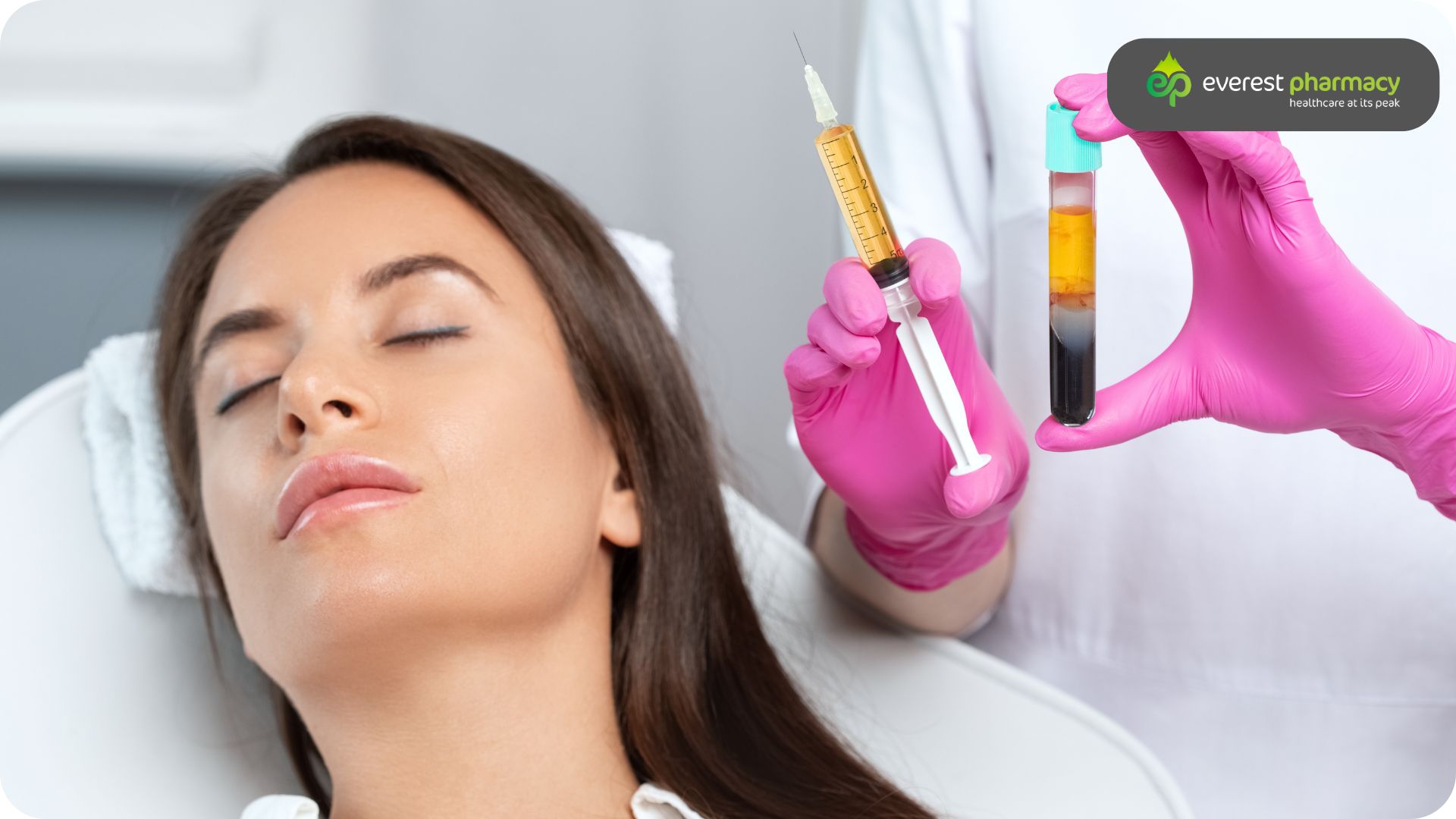
Platelet-rich Plasma Therapy is an autologous procedure. It uses your own blood. Platelets are the cells in your bloodstream responsible for healing. They contain a range of growth factors (PDGF, VEGF, FGF, EGF, TGF-β, KGF) that stimulate tissue repair, collagen production, and new blood vessel formation.
By concentrating these platelets and applying them directly to the treatment area, we give your body a targeted dose of its own regenerative signalling. The healing cascade that follows is natural. Just accelerated and focused where you want it.
At your appointment, PRP is prepared in four simple stages:
- A small blood sample is drawn from your arm, just like a standard blood test
- The sample is processed in a medical-grade centrifuge to separate out the platelet-rich plasma
- The concentrated plasma is carefully applied or injected into the treatment area
- Your body’s healing response takes over, gradually building new collagen and supporting tissue renewal over the weeks that follow
Because PRP is derived from your own body, there’s no risk of allergic reaction or rejection. At Everest Pharmacy Cheadle Hulme, we use PRP Pure. A UK-manufactured, MHRA-registered kit used by clinics across the UK and Ireland.
PRP at Everest: Skin & Hair
Our service focuses on two core areas. Facial skin rejuvenation and scalp hair restoration.
Treatment Area 1
PRP for Face & Skin
PRP can support skin renewal across the face, neck, décolletage and hands. It’s a popular option for patients looking for a natural, non-surgical approach to softening signs of ageing and improving overall skin quality.
Commonly treated concerns:
- Fine lines and early wrinkles
- Uneven skin tone and dullness
- Dark spots and sun damage
- Acne scarring and skin texture
- Tired or thinning skin on the neck
- Ageing skin on the hands
Treatment Area 2
PRP for Hair Restoration
PRP is widely used to support hair density and scalp health. It may help where hair is thinning. Often chosen by patients who want a drug-free, autologous option rather than long-term medication.
PRP scalp treatment may help:
- Support stronger, healthier hair growth
- Improve the look of thinning areas
- Strengthen existing hair
- Improve overall scalp condition
- Complement other hair-loss approaches
PRP tends to work best when started earlier rather than later. A consultation lets us assess your individual situation and build a realistic plan based on what we can actually achieve.
What to Expect at Your Appointment
A typical PRP session takes 45 to 60 minutes from start to finish. Here’s how it works:
10 mins
Consultation
Your Independent Prescriber pharmacist reviews your goals, medical history and any medications to confirm PRP is suitable for you.
5 mins
Blood Draw
A small blood sample is taken from your arm, exactly like a routine blood test.
8 mins
Centrifuge Processing
Your sample is spun in a medical-grade centrifuge to isolate the platelet-rich plasma.
5 mins
Preparation
The skin or scalp is cleansed, and numbing cream is applied where appropriate to keep things comfortable.
15–20 mins
PRP Application
The plasma is carefully injected or applied to the treatment area. This is the core of the treatment.
5 mins
Aftercare & Plan
You’ll leave with clear aftercare instructions and your follow-up sessions booked in.
Treatment Course & Timeline +
PRP works best as a short course of sessions rather than a one-off. For most patients, we recommend:
- An initial course of three sessions, spaced approximately four weeks apart
- A maintenance session every 8 to 12 months after that, depending on your response and goals
Because PRP supports your body’s own regeneration, results build gradually. Many patients notice skin looking fresher or hair feeling denser after the second or third session, with further improvements in the months that follow. Everyone responds differently. That’s why we prioritise an honest conversation at consultation about what you can expect.
Individual results vary and cannot be guaranteed. Your consultation will give you a realistic sense of what PRP can achieve for your specific situation.
Is PRP Right for You? +
PRP is well-tolerated by most healthy adults, but it isn’t suitable for everyone. Because PRP relies on your body’s natural healing response, certain medical conditions and medications can affect whether it’s safe or sensible to go ahead.
When we might not treat
Your pharmacist may advise against PRP or recommend you see your GP first if any of the following apply:
- Pregnancy or breastfeeding
- Active infection or inflammatory skin condition in or near the treatment area
- A blood disorder, low platelet count, or clotting factor deficiency
- Anticoagulant (blood-thinning) medication — this may extend bruising and affect platelet function
- A cancer diagnosis within the last five years
- Autoimmune conditions that affect healing
- Very high cholesterol (hyperlipidaemia)
This list isn’t exhaustive. Your consultation will cover your full medical history, so we can give you honest, individual advice on whether PRP is the right option for you. If it isn’t, we’ll explain why and point you toward better alternatives.
Aftercare: What to Expect After Treatment +
PRP aftercare is straightforward, but knowing what’s normal helps. Especially in the first 48 hours.
In the first 24 to 48 hours
- Redness and mild swelling in the treated area are normal and usually settle within a day or two
- Tenderness, stinging or itching is common and short-lived
- Occasional pinpoint bruising can happen, especially around the eye area
- Mild tightness as the skin responds to the growth factors
In the following days
- Skin may flake slightly as surface cells renew. Don’t pick or peel — let it come away naturally
- Makeup can usually be applied from the next day once skin has settled
- Normal skincare can resume after 3 to 5 days, avoiding strong actives like retinoids or acids in the meantime
General aftercare guidance
- Don’t touch, rub or massage the treated area until pores have closed
- Use gentle cleansers and warm water only for the first couple of days
- Avoid strenuous exercise, saunas, steam rooms and hot showers for 24 to 48 hours
- Avoid alcohol for at least 24 hours
- Stay out of intense sunlight and sunbeds for at least a week, and use SPF 50 daily
- Avoid waxing, electrolysis or laser hair removal on the treated area for at least a week
- Stay well hydrated — it supports your skin’s response to the treatment
You’ll receive a printed aftercare sheet at your appointment. Contact the branch at any time if you have concerns about how your skin or scalp is responding.
Your PRP Therapy Clinic in Manchester
PRP therapy at Everest Pharmacy is currently offered at our Cheadle Hulme branch, led by our Independent Prescriber pharmacist Amjed Zafar. All appointments are by booking only, so we can make sure your clinician is available and the centrifuge is prepared ahead of your session.
Everest Pharmacy Clinic
Cheadle Hulme
Address:
The Precinct, Cheadle Hulme,
Cheadle SK8 5BB
Phone:
0161 486 9110
Lead clinician:
Amjed Zafar (MPharm, NMP)
Independent Prescriber Pharmacist
Opening hours:
Mon–Fri: 09:00–18:00
Sat: 09:00–17:30
Sun: Closed
PRP appointments:
By booking only. Consultation required before first treatment.
Coming soon to more Everest Pharmacy branches across the Greater Manchester area.
Book Your PRP Consultation in Manchester
Every PRP plan starts with an honest consultation about your goals, suitability, and what we can realistically achieve. Book below, or call Everest Pharmacy Cheadle Hulme on 0161 486 9110.
Frequently Asked Questions
Is PRP safe?
PRP uses your own blood, which means the risk of allergic reaction or disease transmission is very low. All our equipment is sterile and single-use, and your treatment is delivered by a trained clinician. As with any injectable procedure, some bruising, swelling or tenderness is normal, but serious complications are rare when PRP is performed correctly.
Does PRP hurt?
Most patients describe PRP as mildly uncomfortable rather than painful. The blood draw feels like a standard blood test, and the injections feel like small pinches. Where appropriate, we apply a numbing cream to the treatment area beforehand to keep things comfortable.
How soon will I see results?
PRP works gradually. Most patients notice skin feeling fresher or hair density improving after the second or third session, with continued improvements over the months that follow. Because PRP supports natural regeneration, it’s a gradual change rather than an immediate cosmetic fix.
How many sessions will I need?
We recommend a standard course of three sessions spaced approximately four weeks apart, followed by a maintenance session every 8 to 12 months. Your clinician may suggest adjustments based on your skin or scalp condition and how you respond.
Is there any downtime?
Most patients return to their normal routine the same day. You may have some mild redness or swelling for 24 to 48 hours, and occasionally small areas of bruising, especially around the eyes. We recommend avoiding strenuous exercise, alcohol and heat exposure for a day or two.
Can PRP be combined with other treatments?
Yes. PRP is often combined with microneedling to support deeper absorption of growth factors, particularly for skin rejuvenation. It can also complement a wider skincare plan. Your consultation will cover whether a combined approach is right for you.
Can PRP replace a hair transplant?
PRP supports existing hair follicles and may help improve density where hair is thinning, but it doesn’t create new hair where follicles have been lost. For advanced hair loss, PRP is often used alongside other approaches rather than as a standalone solution. Your consultation will give you an honest assessment of what PRP can realistically do for you.
Do I need to do anything before my appointment?
Yes. We ask that you are well hydrated for 1–2 days before treatment, as this makes the blood draw easier and supports the quality of the plasma. Avoid alcohol for 24 hours beforehand, and tell us about any medications or supplements you’re taking — especially blood thinners or anti-inflammatories.
Which branches offer PRP?
PRP therapy is currently available at our Cheadle Hulme branch only, led by Amjed Zafar (MPharm, NMP). We’re planning to extend the service to more Everest Pharmacy branches across Greater Manchester over the coming months. In the meantime, patients from across Greater Manchester are welcome to book at Cheadle Hulme.
Is PRP available on the NHS?
Aesthetic PRP treatment is not funded by the NHS. It’s a private service, and our pricing is designed to be transparent and comparable to other independent Manchester clinics.